
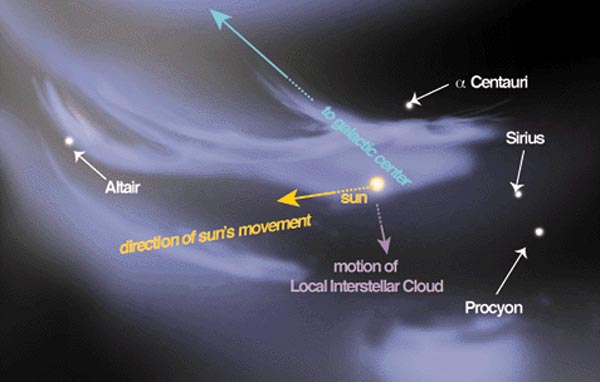
First measured in the early-seventies, the interstellar wind is far from a calm, consistent breeze. Rather, as new detailed measurements show, it’s a blustery, fickle gale.
From ars technica:
Interstellar space—the region between stars in our galaxy—is fairly empty. There are still enough atoms in that space to produce a measurable effect as the Sun orbits the galactic center, however. The flow of these atoms, known as the interstellar wind, provides a way to study interstellar gas, which moves independently of the Sun’s motion.
A new analysis of 40 years of data showed that the interstellar wind has changed direction and speed over time, demonstrating that the environment surrounding the Solar System changes measurably as well. Priscilla Frisch and colleagues compared the results from several spacecraft, both in Earth orbit and interplanetary probes. The different positions and times in which these instruments operated revealed that the interstellar wind has increased slightly in speed. Additional measurements revealed that the flow of atoms has shifted somewhere between 4.4 degrees and 9.2 degrees. Both these results indicate that the Sun is traveling through a changing environment, perhaps one shaped by turbulence in interstellar space.
The properties of the Solar System are dominated by the Sun’s gravity, magnetic field, and the flow of charged particles outward from its surface. However, a small number of electrically neutral particles—mostly light atoms—pass through the Solar System. These particles are part of the local interstellar cloud (LIC), a relatively hot region of space governed by its internal processes.
Neutral helium is the most useful product of the interstellar wind flowing through the Solar System. Helium is abundant, comprising roughly 25 percent of all interstellar atoms. In its electrically neutral form, helium is largely unaffected by magnetic fields, both from the Sun and within the LIC. The present study also considered neutral oxygen and nitrogen atoms, which are far less abundant, but more massive and therefore less strongly jostled even than helium.
When helium atoms flow through the Solar System, their paths are curved by the Sun’s gravity depending on how quickly they are moving. Slower atoms are more strongly affected than faster ones, so the effect is a cone of particle trajectories. The axis of that focusing cone is the dominant direction of the interstellar wind, while the width of the cone indicates how much variation in particle speeds is present, a measure of the speed and turbulence in the LIC.
The interstellar wind was first measured in the 1970s by missions such as the Mariner 10 (which flew by Venus and Mercury) from the United States and the Prognoz 6 satellite from the Soviet Union. More recently, the Ulysses spacecraft in solar orbit, the MESSENGER probe studying Mercury, and the IBEX (Interstellar Boundary EXplorer) mission collected data from several perspectives within the Solar System.
Read the entire article here.
Image: Local interstellar cloud. Courtesy of NASA.

 [div class=attrib]From Ars Technica:[end-div]