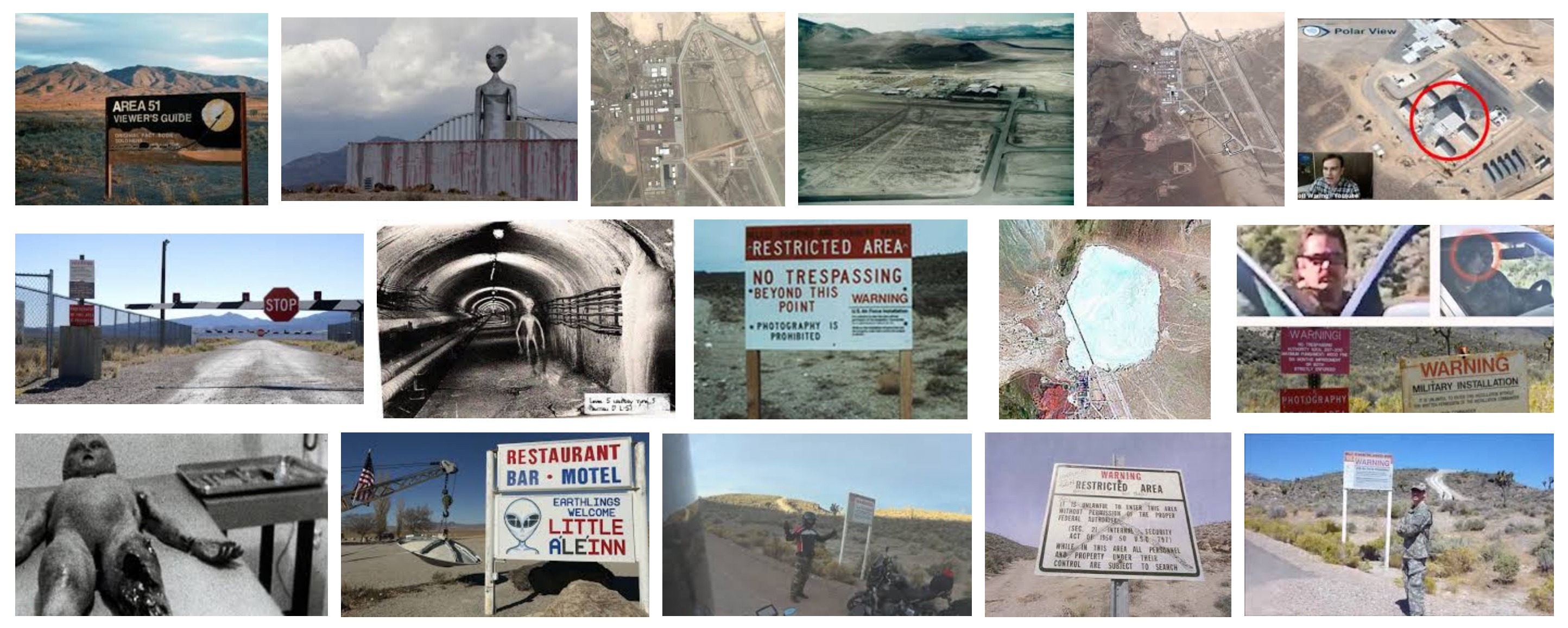
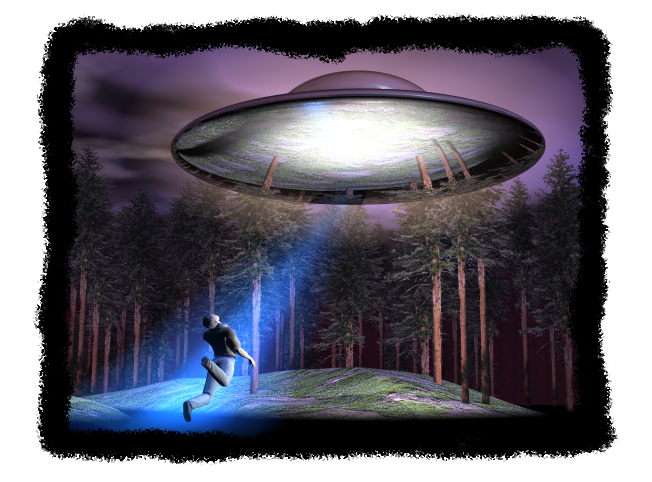
What to believe about Area 51? Over the decades it has inspired hundreds of conspiratorial theories — extra-terrestrial spaceship landings, alien abductions, illegal governmental experimentation. Indeed, an entire tourist-based industry has arisen to attract myth-seekers to the Nevada desert. One thing does seem to be true: there’s a lot going on behind the barbed wire fences and security gates, and it’s probably all military.
From StumbleUpon:
In the middle of the barren Nevada desert, there’s a dusty unmarked road that leads to the front gate of Area 51. It’s protected by little more than a chain link fence, a boom gate, and intimidating trespassing signs. One would think that America’s much mythicized top secret military base would be under closer guard, but make no mistake. They are watching.
Beyond the gate, cameras see every angle. On the distant hilltop, there’s a white pickup truck with a tinted windshield peering down on everything below. Locals says the base knows every desert tortoise and jackrabbit that hops the fence. Others claim there are embedded sensors in the approaching road.
What exactly goes on inside of Area 51 has led to decades of wild speculation. There are, of course, the alien conspiracies that galactic visitors are tucked away somewhere inside. One of the more colorful rumors insists the infamous 1947 Roswell crash was actually a Soviet aircraft piloted by mutated midgets and the wreckage remains on the grounds of Area 51. Some even believe that the U.S. government filmed the 1969 moon landing in one of the base’s hangars.
For all the myths and legends, what’s true is that Area 51 is real and still very active. There may not be aliens or a moon landing movie set inside those fences, but something is going on and only a select few are privy to what’s happening further down that closely-monitored wind-swept Nevada road. “The forbidden aspect of Area 51 is what makes people want to know what’s there,” says aerospace historian and author Peter Merlin who’s been researching Area 51 for more than three decades.
“And there sure is still a lot going on there.”
Read the entire article here.
Image courtesy of Google Search.
 On January 1, 2017, the idea of
 We all need heroes. So, if you wish to become one, you would stand a better chance if you took your dying breaths atop a hill. Also, it would really help your cause if you arrived via virgin birth.

 Should we blame the creative originators of fake news, conspiracy theories, disinformation and click-bait hype? Or, should we blame the media for disseminating, spinning and aggrandizing these stories for their own profit or political motives? Or, should we blame us — the witless consumers.