Monthly Archives: June 2011

Thursday, June 30, 2011

Banned and Challenged Books: A Summer Reading List

Each year the American Library Association publishes a list of attempts by groups and individuals to have books banned from classrooms, libraries and other public places in the United States. The list includes classics such as Ulysses, 1984, Beloved, Gone With the Wind, and The Lord of the Rings. So, if you’re at a loss this summer for a good book in which to get lost, pick one (or three) from the list below and mark one up for the freedom of ideas.

From American Library Association:

The titles below represent banned or challenged books on that list ( see the entire list here). For more information on why these books were challenged, visit challenged classics and the Banned Books Week Web site

...read more
Posted in Arts and Letters, Literature | Tagged | Leave a comment

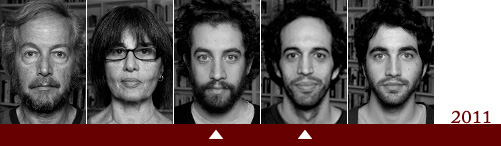
The Arrow of Time

No, not a cosmologist’s convoluted hypothesis as to why time moves in only (so far discovered) one direction. The arrow of time here is a thoroughly personal look at the linearity of the 4th dimension and an homage to the family portrait in the process.

The family takes a “snapshot” of each member at the same time each year; we’ve just glimpsed the latest for 2011. And, in so doing they give us much to ponder on the nature of change and the nature of stasis.

From Diego Goldberg and family:

Catch all the intervening years between 1976 and 2011 at theSource here.

Send to Kindle
Posted in Idea Soup | Tagged , , | Leave a comment
Wednesday, June 29, 2011

More subatomic spot changing

From the Economist:

IN THIS week’s print edition we report a recent result from the T2K collaboration in Japan which has found strong hints that neutrinos, the elusive particles theorists believe to be as abundant in the universe as photons, but which almost never interact with anything, are as fickle as they are coy.

...read more
Posted in BigBang | Tagged , , , | Leave a comment

Solar power from space: Beam it down, Scotty

From the Economist:

THE idea of collecting solar energy in space and beaming it to Earth has been around for at least 70 years. In “Reason”, a short story by Isaac Asimov that was published in 1941, a space station transmits energy collected from the sun to various planets using microwave beams.

The advantage of intercepting sunlight in space, instead of letting it find its own way through the atmosphere, is that so much gets absorbed by the air. By converting it to the right frequency first (one of the so-called windows in the atmosphere, in which little energy is absorbed) a space-based collector could, enthusiasts claim, yield on average five times as much power as one located on the ground.

...read more
Posted in Technica | Tagged | Leave a comment

Largest cosmic structures ‘too big’ for theories

From New Scientist:

Space is festooned with vast “hyperclusters” of galaxies, a new cosmic map suggests. It could mean that gravity or dark energy – or perhaps something completely unknown – is behaving very strangely indeed.

We know that the universe was smooth just after its birth. Measurements of the cosmic microwave background radiation (CMB), the light emitted 370,000 years after the big bang, reveal only very slight variations in density from place to place. Gravity then took hold and amplified these variations into today’s galaxies and galaxy clusters, which in turn are arranged into big strings and knots called superclusters, with relatively empty voids in between.

On even larger scales, though, cosmological models say that the expansion of the universe should trump the clumping effect of gravity. That means there should be very little structure on scales larger than a few hundred million light years across.

...read more
Posted in BigBang | Tagged , | 1 Comment
Tuesday, June 28, 2011

Life of a Facebook Photo

Before photo-sharing, photo blogs, photo friending, “PhotoShopping” and countless other photo-enabled apps and services, there was compose, point, focus, click, develop, print. The process seemed a lot simpler way back then. Perhaps, this was due to lack of options for both input and output. Input? Simple. Go buy a real camera. Output? Simple. Slide or prints. The end.

The options for input and output have exploded by orders of magnitude over the last couple of decades. Nowadays, even my toaster can take pictures and I can output them on my digital refrigerator, sans, of course, real photographs with that limp, bendable magnetic backing. The entire end-to-end process of taking a photograph and sharing it with someone else is now replete with so many choices and options that today it seems to have become inordinately more complex.

So, to help all prehistoric photographers like me, here’s an interesting process flow for your digital images in the age of Facebook.

...read more
Posted in Technica | Tagged , , , , , | Leave a comment
Monday, June 27, 2011

Evolution machine: Genetic engineering on fast forward

From the New Scientist:

Automated genetic tinkering is just the start – this machine could be used to rewrite the language of life and create new species of humans

IT IS a strange combination of clumsiness and beauty. Sitting on a cheap-looking worktop is a motley ensemble of flasks, trays and tubes squeezed onto a home-made frame. Arrays of empty pipette tips wait expectantly. Bunches of black and grey wires adorn its corners. On the top, robotic arms slide purposefully back and forth along metal tracks, dropping liquids from one compartment to another in an intricately choreographed dance. Inside, bacteria are shunted through slim plastic tubes, and alternately coddled, chilled and electrocuted. The whole assembly is about a metre and a half across, and controlled by an ordinary computer.

...read more
Posted in BigBang | Tagged , | Leave a comment

MondayPoem: Morning In The Burned House

Morning In The Burned House, Margaret Atwood

In the burned house I am eating breakfast.
You understand: there is no house, there is no breakfast,
yet here I am.

The spoon which was melted scrapes against
the bowl which was melted also.
No one else is around.

Where have they gone to, brother and sister,
mother and father? Off along the shore,
perhaps. Their clothes are still on the hangers,

their dishes piled beside the sink,
which is beside the woodstove
with its grate and sooty kettle,

every detail clear,
tin cup and rippled mirror.
The day is bright and songless,

the lake is blue, the forest watchful.
In the east a bank of cloud
rises up silently like dark bread.

I can see the swirls in the oilcloth,
I can see the flaws in the glass,
those flares where the sun hits them.

I can’t see my own arms and legs
or know if this is a trap or blessing,
finding myself back here, where everything

in this house has long been over,
kettle and mirror, spoon and bowl,
including my own body,

...read more
Posted in Arts and Letters, Literature | Tagged , , | Leave a comment
Saturday, June 25, 2011

Online Advertising Spaghetti

The technology and business model that is online advertising has evolved and matured significantly since the early days of “pay-per-click”. The team at Infographics Labs does a wonderful job below of bringing the current model, in all its spaghetti-like glory, to life.

From Infographic Labs:

Online Advertising

Online Advertising by Infographiclabs

Send to Kindle
Posted in Technica | Tagged , , | Leave a comment
Friday, June 24, 2011

Nick Risinger’s Photopic Sky Survey

Big science covering scales from the microscopic to the vastness of the universe continues to deliver stunning new insights, now on a daily basis. I takes huge machines such as the Tevatron at Fermilab, CERN’s Large Hadron Collider, NASA’s Hubble Telescope and the myriad other detectors, arrays, spectrometers, particle smashers to probe some of our ultimate questions. The results from these machines bring us fantastic new perspectives and often show us remarkable pictures of the very small and very large.

Then there is Nick Risinger’s Photopic Sky Survey. No big science, no vast machines — just Nick Risinger, accompanied by retired father, camera equipment and 45,000 miles of travels capturing our beautiful night sky as never before.

From Nick Risinger:

...read more
Posted in BigBang | Tagged , , | Leave a comment
Thursday, June 23, 2011

Susan Wolf and Meaningfulness

From PEA Soup:

A lot of interesting work has been done recently on what makes lives meaningful. One brilliant example of this is Susan Wolf’s recent wonderful book Meaning in Life and Why It Matters. It consists of two short lectures, critical commentaries by John Koethe, Robert M. Adams, Nomy Arpaly, and Jonathan Haidt, and responses by Wolf herself. What I want to do here is to introduce quickly Wolf’s ‘Fitting Fulfillment’ View, and then I’ll raise a potential objection to it.

...read more
Posted in Arts and Letters, Literature | Tagged , , | Leave a comment
Wednesday, June 22, 2011

How your dad’s music influences your taste

From Sonos:

There’s no end to the reasons why you listen to the music you do today, but we’re willing to bet that more than a few of you were subjected to your father’s music at some point in the past (or present). So that leads to the question: what do dear old dad’s listening habits say about the artists in your repertoire? In honor of Father’s Day, we tried our hand at finding out.

More from the Source here.

Send to Kindle
Posted in Idea Soup | Tagged , | Leave a comment
Tuesday, June 21, 2011

The Technology of Personalization and the Bubble Syndrome

A decade ago in another place and era during my days as director of technology research for a Fortune X company I tinkered with a cool array of then new personalization tools. The aim was simple, use some of these emerging technologies to deliver a more customized and personalized user experience for our customers and suppliers. What could be wrong with that? Surely, custom tools and more personalized data could do nothing but improve knowledge and enhance business relationships for all concerned. Our customers would benefit from seeing only the information they asked for, our suppliers would benefit from better analysis and filtered feedback, and we, the corporation in the middle, would benefit from making everyone in our supply chain more efficient and happy. Advertisers would be even happier since with more focused data they would be able to deliver messages that were increasingly more precise and relevant based on personal context.

...read more
Posted in tD, Technica | Tagged , , , , | Leave a comment

Cosmic Smoothness

Simulations based on the standard cosmological model, as shown here, indicate that on very large distance scales, galaxies should be uniformly distributed. But observations show a clumpier distribution than expected. (The length bar represents about $2.3$ billion light years.)From American Physical Society, Michael J. Hudson:

The universe is expected to be very nearly homogeneous in density on large scales. In Physical Review Letters, Shaun Thomas and colleagues from University College London analyze measurements of the density of galaxies on the largest spatial scales so far—billions of light years—and find that the universe is less smooth than expected. If it holds up, this result will have important implications for our understanding of dark matter, dark energy, and perhaps gravity itself.

In the current standard cosmological model, the average mass-energy density of the observable universe consists of 5% normal matter (most of which is hydrogen and helium), 23% dark matter, and 72% dark energy. The dark energy is assumed to be uniform, but the normal and dark matter are not. The balance between matter and dark energy determines both how the universe expands and how regions of unusually high or low matter density evolve with time.

...read more
Posted in BigBang | Tagged , , , | Leave a comment
Monday, June 20, 2011

Lemonade without the Lemons: New Search Engine Looks for Uplifting News

From Scientific American:

Good news, if you haven’t noticed, has always been a rare commodity. We all have our ways of coping, but the media’s pessimistic proclivity presented a serious problem for Jurriaan Kamp, editor of the San Francisco-based Ode magazine—a must-read for “intelligent optimists”—who was in dire need of an editorial pick-me-up, last year in particular. His bright idea: an algorithm that can sense the tone of daily news and separate the uplifting stories from the Debbie Downers.

...read more
Posted in Technica | Tagged , , | Leave a comment

Self-Published Author Sells a Million E-Books on Amazon

From ReadWriteWeb:

Since the Kindle’s launch, Amazon has heralded each new arrival into what it calls the “Kindle Million Club,” the group of authors who have sold over 1 million Kindle e-books. There have been seven authors in this club up ’til now – some of the big names in publishing: Stieg Larsson, James Patterson, and Nora Roberts for example.

But the admission today of the eighth member of this club is really quite extraordinary. Not because John Locke is a 60 year old former insurance salesman from Kentucky with no writing or publishing background. But because John Locke has accomplished the feat of selling one million e-books as a completely self-published author.

...read more
Posted in Technica | Tagged , | Leave a comment

Book Review: Solar. Ian McEwan

Solar is a timely, hilarious novel from the author of Atonement that examines the self-absorption and (self-)deceptions of Nobel Prize-winning physicist Michael Beard. With his best work many decades behind him Beard trades on his professional reputation to earn continuing financial favor, and maintain influence and respect amongst his peers. And, with his personal life in an ever-decreasing spiral, with his fifth marriage coming to an end, Beard manages to entangle himself in an impossible accident which has the power to re-shape his own world, and the planet in the process.

...read more
Posted in Book Reviews | Tagged , , | Leave a comment
Sunday, June 12, 2011

Book Review: The Social Animal. David Brooks

David Brooks brings us a detailed journey through the building blocks of the self in his new book, The Social Animal: A Story of Love, Character and Achievement. With his insight and gift for narrative Brooks weaves an engaging and compelling story of Erica and Harold. Brooks uses the characters of Erica and Harold as platforms on which he visualizes the results of numerous psychological, social and cultural studies. Placed in contemporary time the two characters show us a holistic picture in practical terms of the unconscious effects of physical and social context on behavioral and character traits. The narrative takes us through typical life events and stages: infancy, childhood, school, parenting, work-life, attachment, aging. At each stage, Brooks illustrates his views of the human condition by selecting a flurry of facts and anecdotal studies.

...read more
Posted in Book Reviews | Tagged , , , , | Leave a comment