
 Imagine a world without books; you’d have to commit useful experiences, narratives and data to handwritten form and memory.Imagine a world without the internet and real-time search; you’d have to rely on a trusted expert or a printed dictionary to find answers to your questions. Imagine a world without the written word; you’d have to revert to memory and oral tradition to pass on meaningful life lessons and stories.
Technology is a wonderfully double-edged mechanism. It brings convenience. It helps in most aspects of our lives. Yet, it also brings fundamental cognitive change that brain scientists have only recently begun to fathom. Recent studies, including the one cited below from Columbia University explore this in detail.
[div class=attrib]From Technology Review:[end-div]
A study says that we rely on external tools, including the Internet, to augment our memory.
The flood of information available online with just a few clicks and finger-taps may be subtly changing the way we retain information, according to a new study. But this doesn’t mean we’re becoming less mentally agile or thoughtful, say the researchers involved. Instead, the change can be seen as a natural extension of the way we already rely upon social memory aids—like a friend who knows a particular subject inside out.
Researchers and writers have debated over how our growing reliance on Internet-connected computers may be changing our mental faculties. The constant assault of tweets and YouTube videos, the argument goes, might be making us more distracted and less thoughtful—in short, dumber. However, there is little empirical evidence of the Internet’s effects, particularly on memory.
Betsy Sparrow, assistant professor of psychology at Columbia University and lead author of the new study, put college students through a series of four experiments to explore this question.
One experiment involved participants reading and then typing out a series of statements, like “Rubber bands last longer when refrigerated,” on a computer. Half of the participants were told that their statements would be saved, and the other half were told they would be erased. Additionally, half of the people in each group were explicitly told to remember the statements they typed, while the other half were not. Participants who believed the statements would be erased were better at recalling them, regardless of whether they were told to remember them.
[div class=attrib]More from theSource here.[end-div]
 One of the most fascinating and (in)famous experiments in social psychology began in the bowels of Stanford University 40 years ago next month. The experiment intended to evaluate how people react to being powerless. However, on conclusion it took a broader look at role assignment and reaction to authority.
 [div class=attrib]From Salon:[end-div]



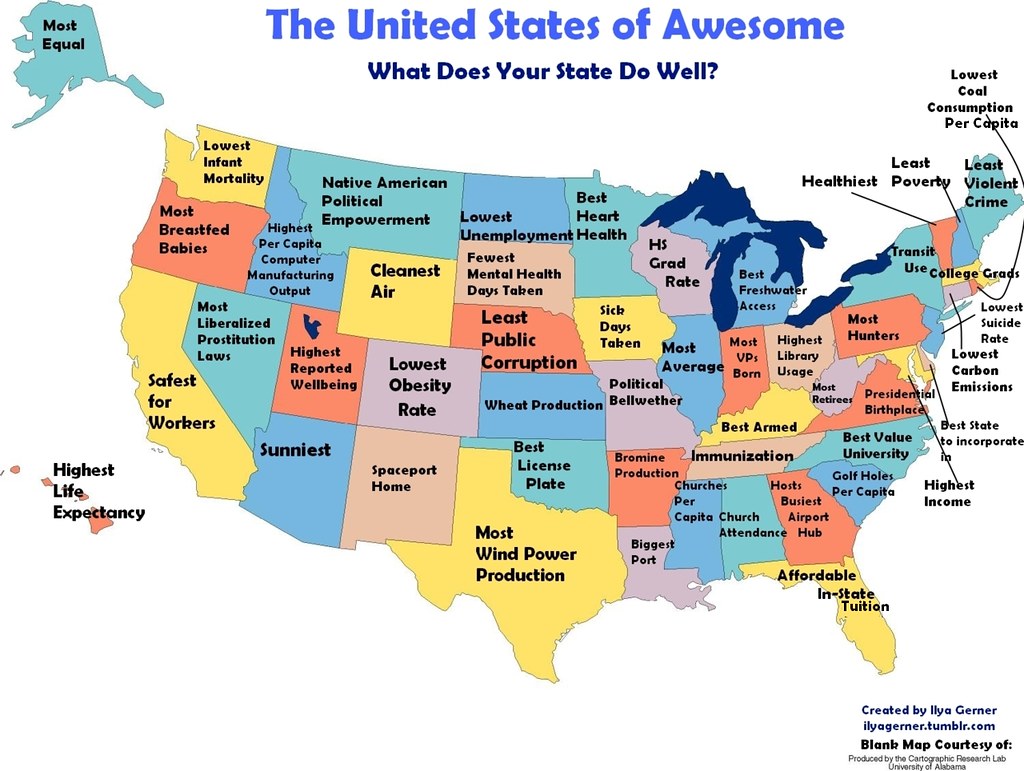 [div class=attrib]From Frank Jacobs / BigThink:[end-div]
 Hilarious and disturbing. I suspect Jon Ronson would strike a couple of checkmarks in the Hare PCL-R Checklist against my name for finding his latest work both hilarious and disturbing. Would this, perhaps, make me a psychopath?
 [div class=attrib]Echo and Narcissus, John William Waterhouse [Public domain], via Wikimedia Commons[end-div]
 [div class=attrib]Let America Be America Again, Langston Hughes[end-div]
 [div class=attrib]From Evolutionary Philosophy:[end-div]
 [div class=attrib]From Scientific American:[end-div]


 [div class=attrib]From the Economist:[end-div]
 [div class=attrib]From New Scientist:[end-div]
 [div class=attrib]From the New Scientist:[end-div]
 Big science covering scales from the microscopic to the vastness of the universe continues to deliver stunning new insights, now on a daily basis. I takes huge machines such as the Tevatron at Fermilab, CERN’s Large Hadron Collider, NASA’s Hubble Telescope and the myriad other detectors, arrays, spectrometers, particle smashers to probe some of our ultimate questions. The results from these machines bring us fantastic new perspectives and often show us remarkable pictures of the very small and very large.