Monthly Archives: February 2012

Wednesday, February 29, 2012

Daddy’s Girl, Yes; Mother’s Boy, No

Western social norms tolerate a strong bond between father and daughter; it’s OK to be a daddy’s girl. Yet, for a mother’s boy and mothers of mothers’ boys it’s a different story. In fact, a strong bond between mother and son is frequently looked upon with derision. Just check out the mother’s body “definition” in Wikipedia; there’s no formal entry for Daddy’s Girl.

Why is this, and is it right?

Excerpts below from the forthcoming book “From “The Mama’s Boy Myth” by Kate Stone Lombardi.

From the Wall Street Journal:

...read more
Posted in Idea Soup | Tagged , , | Leave a comment
Tuesday, February 28, 2012

Social Skin

From Anthropology in Practice:

Are you inked?

I’m not, though I’ve thought about it seriously and have a pretty good idea of what I would get and where I would put it—if I could work up the nerve to get in the chair. I’ll tell you one thing: It most certainly is not a QR code like Fred Bosch, who designed his tattoo to link to something new every time it’s scanned. While the idea is intriguing and presents an interesting re-imagining of tattoos in the digital age, it seems to run counter to the nature of tattoos.

Tattoo As Talisman and Symbol

...read more
Posted in Idea Soup | Tagged , , , | Leave a comment
Monday, February 27, 2012

Need Creative Inpiration? Take a New Route to Work

From Miller-McCune:

Want to boost your creativity? Tomorrow morning, pour some milk into an empty bowl, and then add the cereal.

That may sound, well, flaky. But according to a newly published study, preparing a common meal in reverse order may stimulate innovative thinking.

Avoiding conventional behavior at the breakfast table “can help people break their cognitive patterns, and thus lead them to think more flexibly and creatively,” according to a research team led by psychologist Simone Ritter of Radboud University Nijmegen in the Netherlands.

She and her colleagues, including Rodica Ioana Damian of the University of California, Davis, argue that “active involvement in an unusual event” can trigger higher levels of creativity. They note this activity can take many forms, from studying abroad for a semester to coping with the unexpected death of a loved one.
But, writing in the Journal of Experimental Social Psychology, they provide evidence that something simpler will suffice.

...read more
Posted in BigBang | Tagged , | Leave a comment
Sunday, February 26, 2012

What’s in a Name?

Are you a Leszczynska or a Bob? And, do you wish to be liked? Well, sorry Leszczynska. It turns out that having an easily pronounceable name makes you more likable.

From Wired:

Though it might seem impossible, and certainly inadvisable, to judge a person by their name, a new study suggests our brains try anyway.

The more pronounceable a person’s name is, the more likely people are to favor them.

“When we can process a piece of information more easily, when it’s easier to comprehend, we come to like it more,” said psychologist Adam Alter of New York University and co-author of a Journal of Experimental Social Psychology study published in December.

Fluency, the idea that the brain favors information that’s easy to use, dates back to the 1960s, when researchers found that people most liked images of Chinese characters if they’d seen them many times before.

Researchers since then have explored other roles that names play, how they affect our judgment and to what degree.

...read more
Posted in BigBang | Tagged , , | Leave a comment
Saturday, February 25, 2012

The United States of Henry

It is a distinct possibility that had it not been for the graphic tales of violence and sex from the New World around 500 years ago the continent that is now known as America would have taken another label.

Amerigo Vespucci’s westward expeditions between 1497 and 1502 made landfall in what is now Guyana, Venezuela and Brazil. Accounts of these expeditions, with stories of lustful natives having cannibalistic tendencies and life spans of 150 years, caught the public imagination. Present day scholars dispute the authenticity of many of Vespucci’s first hand accounts and letters; in fact the dates and number of Vespucci’s expeditions remains unsettled to this day.

...read more
Posted in Idea Soup | Tagged , | Leave a comment
Friday, February 24, 2012

Your Guide to Online Morality

By most estimates Facebook has around 800 million registered users. This means that its policies governing what is or is not appropriate user content should bear detailed scrutiny. So, a look at Facebook’s recently publicized guidelines for sexual and violent content show a somewhat peculiar view of morality. It’s a view that some characterize as typically American prudishness, but with a blind eye towards violence.

From the Guardian:

...read more
Posted in Idea Soup, Technica | Tagged , , , | Leave a comment
Thursday, February 23, 2012

A Hidden World Revealed Through Nine Eyes

Since mid-2007 the restless nine-eyed cameras of Google Street View have been snapping millions, if not billions, of images of the world’s streets.

The mobile cameras with 360 degree views, perched atop Google’s fleet of specially adapted vehicles, have already covered most of North America, Brazil, South Africa, Australia and large swathes of Europe. In roaming many of the world roadways Google’s cameras have also snapped numerous accidental images: people caught unaware, car accidents, odd views into nearby buildings, eerie landscapes.

Regardless of the privacy issues here, the photographs make for some fascinating in-the-moment art. A number of enterprising artists and photographers have included some of these esoteric Google Street View “out-takes” into their work. A selection from Jon Rafman below. See more of his and Google’s work here.


Send to Kindle
Posted in Art | Tagged , , , | Leave a comment
Wednesday, February 22, 2012

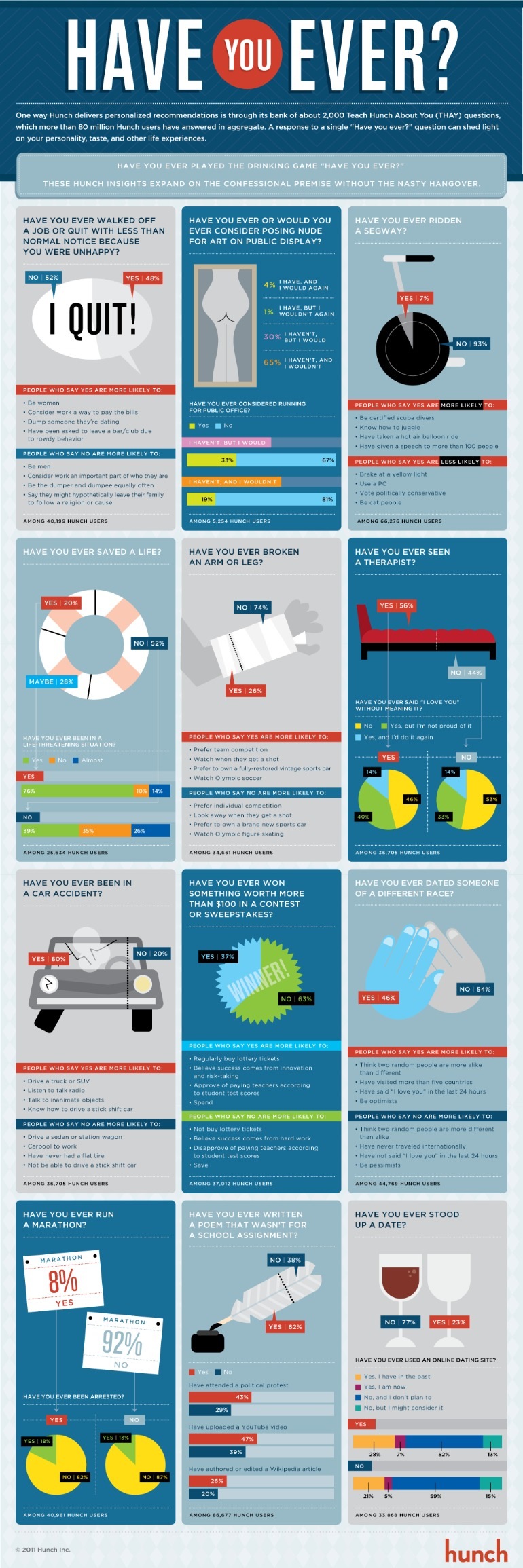
Ever Done Something Out of the Ordinary?

A collection of answers to some fascinating “have you ever ___?” questions.

Infographic courtesy of Hunch:

Send to Kindle
Posted in Idea Soup | Tagged , , | Leave a comment
Tuesday, February 21, 2012

Engineering the Ultimate Solar Power Collector: The Leaf

From Cosmic Log:

Researchers have been trying for decades to improve upon Mother Nature’s favorite solar-power trick — photosynthesis — but now they finally think they see the sunlight at the end of the tunnel.

“We now understand photosynthesis much better than we did 20 years ago,” said Richard Cogdell, a botanist at the University of Glasgow who has been doing research on bacterial photosynthesis for more than 30 years. He and three colleagues discussed their efforts to tweak the process that powers the world’s plant life today in Vancouver, Canada, during the annual meeting of the American Association for the Advancement of Science.

...read more
Posted in Environs | Tagged , , | Leave a comment
Monday, February 20, 2012

Synaesthesia: Smell the Music

From the Economist:

THAT some people make weird associations between the senses has been acknowledged for over a century. The condition has even been given a name: synaesthesia. Odd as it may seem to those not so gifted, synaesthetes insist that spoken sounds and the symbols which represent them give rise to specific colours or that individual musical notes have their own hues.

Yet there may be a little of this cross-modal association in everyone. Most people agree that loud sounds are “brighter” than soft ones. Likewise, low-pitched sounds are reminiscent of large objects and high-pitched ones evoke smallness. Anne-Sylvie Crisinel and Charles Spence of Oxford University think something similar is true between sound and smell.

...read more
Posted in BigBang | Tagged , , | Leave a comment
Sunday, February 19, 2012

Religion for Atheists and the Agape Restaurant

Alain de Botton is a writer of book-length essays on love, travel, architecture and literature. In his latest book, Religion for Atheists, de Botton argues that while the supernatural claims of all religions are entirely false, religions still have important things to teach the secular world. An excerpt from the book below.

From the Wall Street Journal:

One of the losses that modern society feels most keenly is the loss of a sense of community. We tend to imagine that there once existed a degree of neighborliness that has been replaced by ruthless anonymity, by the pursuit of contact with one another primarily for individualistic ends: for financial gain, social advancement or romantic love.

...read more
Posted in Idea Soup, Literature | Tagged , , , | Leave a comment
Saturday, February 18, 2012

Travel Photo Clean-up

We’ve all experienced this phenomenon when on vacation: you’re at a beautiful location with a significant other, friends or kids; the backdrop is idyllic, the subjects are exquisitely posed, you need to preserve and share this perfect moment with a photograph, you get ready to snap the shutter. Then, at that very moment an oblivious tourist, unperturbed locals or a stray goat wander into the picture, too late, the picture is ruined, and it’s getting dark, so there’s no time to reinvent that perfect scene! Oh well, you’ll still be able to talk about the scene’s unspoiled perfection when you get home.

But now, there’s an app for that.

From New Scientist:


It’s the same scene played out at tourist sites the world over: You’re trying to take a picture of a partner or friend in front of some monument, statue or building and other tourists keep striding unwittingly – or so they say - into the frame.

...read more
Posted in Technica | Tagged , , , | Leave a comment
Friday, February 17, 2012

Beautiful Explanations

Each year for the past 15 years Edge has posed a weighty question to a group of scientists, researchers, philosophers, mathematicians and thinkers. For 2012, Edge asked the question, “What Is Your Favorite Deep, Elegant, or Beautiful Explanation?”, to 192 of our best and brightest. Back came 192 different and no-less wonderful answers. We can post but a snippet here, so please visit the Edge, and then make a note to buy the book (it’s not available yet).

Read the entire article here.

The Mysterious Coherence Between Fundamental Physics and Mathematics
Peter Woit, Mathematical Physicist, Columbia University; Author, Not Even Wrong

...read more
Posted in Idea Soup | Tagged , , , | Leave a comment
Thursday, February 16, 2012

Great Architecture

Jonathan Glancey, architecture critic at the Guardian in the UK for the last fifteen years, is moving on to greener pastures, and presumably new buildings. In his final article for the newspaper he reflects on some buildings that have engendered shock and/or awe.

From the Guardian:

Fifteen years is not a long time in architecture. It is the slowest as well as the most political of the arts. This much was clear when I joined the Guardian as its architecture and design correspondent, from the Independent, in 1997. I thought the Millennium Experience (the talk of the day) decidedly dimwitted and said so in no uncertain terms; it lacked a big idea and anything like the imagination of, say, the Great Exhibition of 1851, or the Festival of Britain in 1951.

...read more
Posted in Environs | Tagged | Leave a comment
Wednesday, February 15, 2012

Suburbia as Mass Murderer

Jane Brody over at the Well blog makes a compelling case for the dismantling of suburbia. After all, these so-called “built environments” where we live, work, eat, play and raise our children, are an increasingly serious health hazard.
From the New York Times:

Developers in the last half-century called it progress when they built homes and shopping malls far from city centers throughout the country, sounding the death knell for many downtowns. But now an alarmed cadre of public health experts say these expanded metropolitan areas have had a far more serious impact on the people who live there by creating vehicle-dependent environments that foster obesity, poor health, social isolation, excessive stress and depression.

...read more
Posted in Environs | Tagged , , | Leave a comment
Tuesday, February 14, 2012

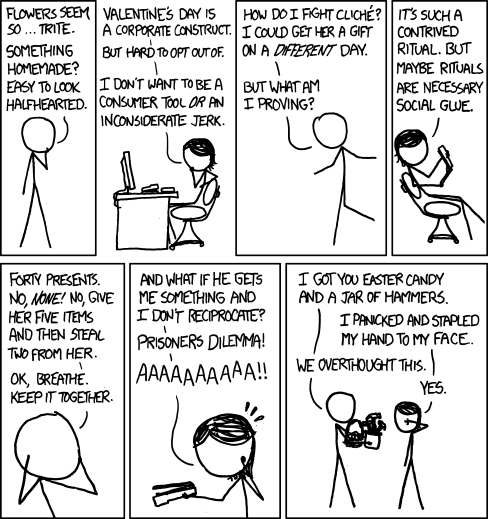
Valentine’s Day

From xkcd:

More from xkcd here.

Send to Kindle
Posted in Idea Soup | Tagged , , , | Leave a comment
Monday, February 13, 2012

Tear-Jerker Dissected

Set aside the fact that having heard Adele’s song “Someone Like You” so often may want to make you cry from trying to escape, science has now found an answer to why the tear-jerker makes you sob.

From the Wall Street Journal:

On Sunday night [February 12, 2012], the British singer-songwriter Adele is expected to sweep the Grammys. Three of her six nominations are for her rollicking hit “Rolling in the Deep.” But it’s her ballad “Someone Like You” that has risen to near-iconic status recently, due in large part to its uncanny power to elicit tears and chills from listeners. The song is so famously sob-inducing that “Saturday Night Live” recently ran a skit in which a group of co-workers play the tune so they can all have a good cry together.

...read more
Posted in Idea Soup | Tagged , , , | Leave a comment
Sunday, February 12, 2012

Pop art + Money = Mind Candy

From the Guardian:

The first pop artists were serious people. The late Richard Hamilton was being double-edged and sceptical when he called a painting Hommage à Chrysler Corp. Far from emptily celebrating what Andy Warhol called “all the great modern things”, pop art in the 1950s and early 1960s took a quizzical, sideways look at what was still a very new world of consumer goods. Claes Oldenburg made floppy, saggy sculptures of stuff, which rendered the new look worn out. Warhol painted car crashes. These artists saw modern life in the same surreal and eerie way as the science fiction writer JG Ballard does in his stories and novels.

...read more
Posted in Art | Tagged , | Leave a comment
Saturday, February 11, 2012

Spooky Action at a Distance Explained

From Scientific American:

Quantum entanglement is such a mainstay of modern physics that it is worth reflecting on how long it took to emerge. What began as a perceptive but vague insight by Albert Einstein languished for decades before becoming a branch of experimental physics and, increasingly, modern technology.

Einstein’s two most memorable phrases perfectly capture the weirdness of quantum mechanics. “I cannot believe that God plays dice with the universe” expressed his disbelief that randomness in quantum physics was genuine and impervious to any causal explanation. “Spooky action at a distance” referred to the fact that quantum physics seems to allow influences to travel faster than the speed of light. This was, of course, disturbing to Einstein, whose theory of relativity prohibited any such superluminal propagation.

...read more
Posted in BigBang | Tagged , , | Leave a comment
Friday, February 10, 2012

Oil, Art and the 0.0001 Percent

From Vanity Fair:

The tiny, oil-rich nation of Qatar has purchased a Paul Cézanne painting, The Card Players, for more than $250 million. The deal, in a single stroke, sets the highest price ever paid for a work of art and upends the modern art market.

If the price seems insane, it may well be, since it more than doubles the current auction record for a work of art. And this is no epic van Gogh landscape or Vermeer portrait, but an angular, moody representation of two Aix-en-Provence peasants in a card game. But, for its $250 million, Qatar gets more than a post-Impressionist masterpiece; it wins entry into an exclusive club. There are four other Cézanne Card Players in the series; and they are in the collections of the Metropolitan Museum of Art, the Musée d’Orsay, the Courtauld, and the Barnes Foundation. For a nation in the midst of building a museum empire, it’s instant cred.

...read more
Posted in Art | Tagged , | Leave a comment
Thursday, February 9, 2012

Yawning and Empathy

From Scientific American:

...read more
Posted in Idea Soup | Tagged , , , | Leave a comment
Wednesday, February 8, 2012

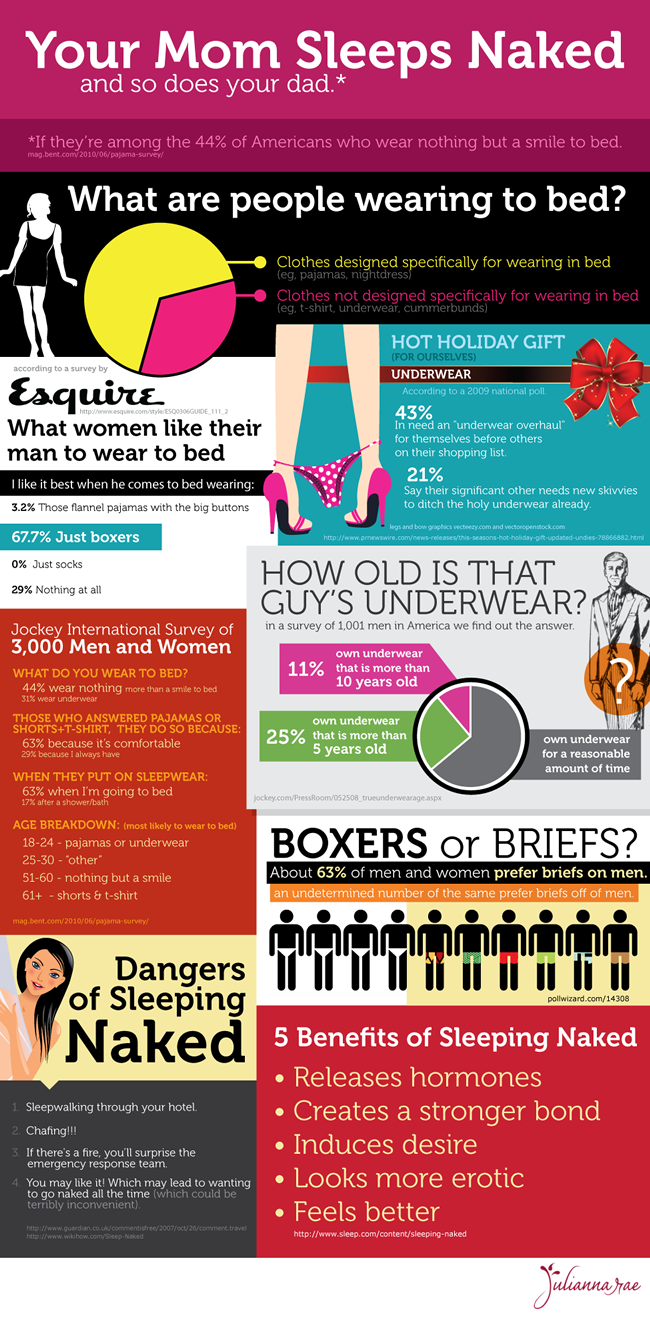
How We Sleep

A fascinating and disturbing infographic from Julianna Rae summarizes what we wear, or don’t wear, at slumber time.

Send to Kindle
Posted in Idea Soup | Tagged , | Leave a comment
Tuesday, February 7, 2012

Women and Pain

New research suggests that women feel pain more intensely than men.
From Scientific American:

When a woman falls ill, her pain may be more intense than a man’s, a new study suggests.

Across a number of different diseases, including diabetes, arthritis and certain respiratory infections, women in the study reported feeling more pain than men, the researchers said.

The study is one of the largest to examine sex differences in human pain perception. The results are in line with earlier findings, and reveal that sex differences in pain sensitivity may be present in many more diseases than previously thought.

Because pain is subjective, the researchers can’t know for sure whether women, in fact, experience more pain than men. A number of factors, including a person’s mood and whether they take pain medication, likely influence how much pain they say they’re in.

...read more
Posted in BigBang | Tagged , , | Leave a comment
Monday, February 6, 2012

L’Entente Cordiale: Parenting the French Way

French children, it seems, unlike their cousins in the United States, don’t suffer temper tantrums, sit patiently at meal-times, defer to their parents, eat all their vegetables, respect adults, and are generally happy. Why is this and should American parents ditch the latest pop psychology handbooks for parenting lessons from La Belle France?

From the Wall Street Journal:

When my daughter was 18 months old, my husband and I decided to take her on a little summer holiday. We picked a coastal town that’s a few hours by train from Paris, where we were living (I’m American, he’s British), and booked a hotel room with a crib. Bean, as we call her, was our only child at this point, so forgive us for thinking: How hard could it be?

...read more
Posted in Idea Soup, Literature | Tagged , , , , | Leave a comment
Sunday, February 5, 2012

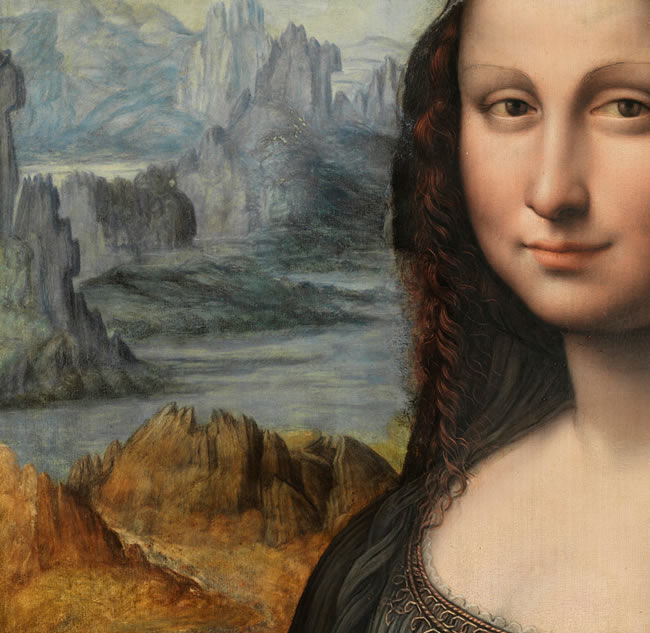
The Other Mona Lisa

From the Guardian:

A contemporaneous copy of the world’s most famous painting has been sensationally discovered by conservators at the Prado in Madrid, allowing us to see the Mona Lisa as she would probably have looked at the time.

In art historical terms, the discovery is nothing short of remarkable. The Prado painting had long been thought to be one of dozens of surviving replicas of Leonardo’s masterpiece, made in the 16th and 17th centuries.

But, the Arts Newspaper reports, recent conservation reveals that the work was in fact painted by a pupil working alongside Leonardo.

The original painting hangs behind glass and with enormous security at the Louvre, a gallery it is unlikely to ever leave. There is also no prospect of it being cleaned in the forseeable future, meaning crowds view a work that, although undeniably beautiful, has several layers of old, cracked varnish.

...read more
Posted in Art | Tagged , , | Leave a comment
Saturday, February 4, 2012

The More Things Stay the Same, the More They Change?

From Scientific American:

Some things never change. physicists call them the constants of nature. Such quantities as the velocity of light, c, Newton’s constant of gravitation, G, and the mass of the electron, me, are assumed to be the same at all places and times in the universe. They form the scaffolding around which the theories of physics are erected, and they define the fabric of our universe. Physics has progressed by making ever more accurate measurements of their values.

...read more
Posted in BigBang | Tagged , , | Leave a comment
Friday, February 3, 2012

P183 – Russia’s Banksy

Russian street artist P183 has been compared with Britain’s Banksy for his bold works criticizing contemporary Russian culture, the political establishment and the art scene.

See more of P183′s works here.

Send to Kindle
Posted in Art | Tagged , , | Leave a comment
Thursday, February 2, 2012

Time for An Over-The-Counter Morality Pill?

Stories of people who risk life and limb to help a stranger and those who turn a blind eye are as current as they are ancient. Almost on a daily basis the 24-hours news cycle carries a heartwarming story of someone doing good to or for another; and seemingly just as often comes the story of indifference. Social and psychological researchers have studied this behavior in humans, and animals, for decades. However, only recently has progress been made in identifying some underlying factors. Peter Singer, a professor of bioethics at Princeton University, and researcher Agata Sagan recap some current understanding.

All of this leads to a conundrum: would it be ethical to market a “morality” pill that would make us do more good more often?

From the New York Times:

...read more
Posted in BigBang | Tagged , , | Leave a comment
Wednesday, February 1, 2012

A Theory of Everything? Nah

A peer-reviewed journal recently published a 100-page scientific paper describing a theory of everything that unifies quantum theory and relativity (a long sought-after goal) with the origin of life, evolution and cosmology. And, best of all the paper contains no mathematics.

The paper written by a faculty member at Case Western Reserve University raises interesting issues about the peer review process and the viral spread of information, whether it’s correct or not.

From Ars Technica:

Physicists have been working for decades on a “theory of everything,” one that unites quantum mechanics and relativity. Apparently, they were being too modest. Yesterday saw publication of a press release claiming a biologist had just published a theory accounting for all of that—and handling the origin of life and the creation of the Moon in the bargain. Better yet, no math!

...read more
Posted in BigBang | Tagged , , , , | Leave a comment