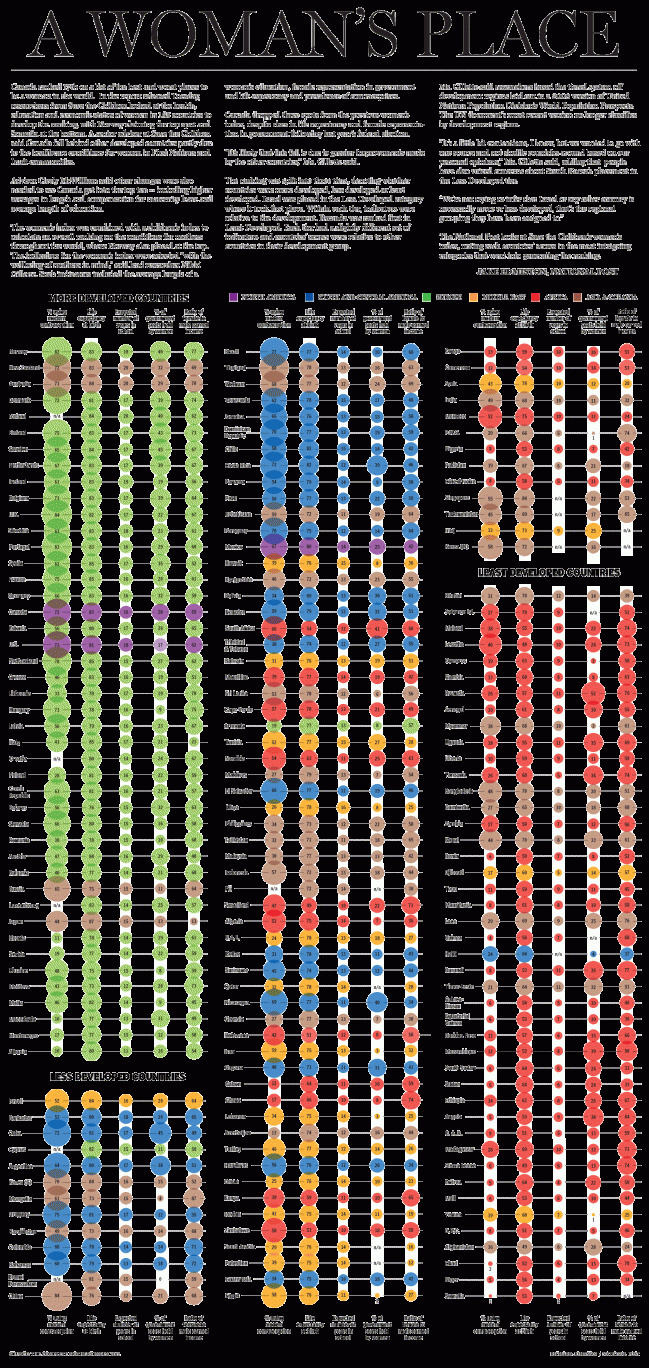
We excerpt an fascinating article from I09 on the association of science fiction to philosophical inquiry. It’s quiet remarkable that this genre of literature can provide such a rich vein for philosophers to mine, often more so than reality itself. Though, it is no coincidence that our greatest authors of science fiction were, and are, amateur philosophers at heart.
[div class=attrib]From i09:[end-div]
People use science fiction to illustrate philosophy all the time. From ethical quandaries to the very nature of existence, science fiction’s most famous texts are tailor-made for exploring philosophical ideas. In fact, many college campuses now offer courses in the philosophy of science fiction.
But science fiction doesn’t just illuminate philosophy — in fact, the genre grew out of philosophy, and the earliest works of science fiction were philosophical texts. Here’s why science fiction has its roots in philosophy, and why it’s the genre of thought experiments about the universe.
Philosophical Thought Experiments As Science Fiction
Science fiction is a genre that uses strange worlds and inventions to illuminate our reality — sort of the opposite of a lot of other writing, which uses the familiar to build a portrait that cumulatively shows how insane our world actually is. People, especially early twenty-first century people, live in a world where strangeness lurks just beyond our frame of vision — but we can’t see it by looking straight at it. When we try to turn and confront the weird and unthinkable that’s always in the corner of our eye, it vanishes. In a sense, science fiction is like a prosthetic sense of peripheral vision.
We’re sort of like the people chained up in on the cave wall, but never seeing the full picture.
Plato is probably the best-known user of allegories — a form of writing which has a lot in common with science fiction. A lot of allegories are really thought experiments, trying out a set of strange facts to see what principles you derive from them. As plenty of people have pointed out, Plato’s Allegory of the Cave is the template for a million “what is reality” stories, from the works of Philip K. Dick to The Matrix. But you could almost see the cave allegory in itself as a proto-science fiction story, because of the strange worldbuilding that goes into these people who have never seen the “real” world. (Plato also gave us an allegory about the Ring of Gyges, which turns its wearer invisible — sound familiar?).
Later philosophers who ponder the nature of existence also seem to stray into weird science fiction territory — like Descartes, raising the notion that he, Descartes, could have existed since the beginning of the universe (as an alternative to God as a cause for Descartes’ existence.) Sitting in his bread oven, Descartes tries to cut himself off from sensory input to see what he can deduce of the universe.
…
And by the same token, the philosophy of human nature often seems to depend on conjuring imaginary worlds, whether it be Hobbes’ “nasty, brutish and short” world without laws, or Rousseau’s “state of nature.” A great believer in the importance of science, Hobbes sees humans as essentially mechanistic beings who are programmed to behave in a selfish fashion — and the state is a kind of artificial human that can contain us and give us better programming, in a sense.
So not only can you use something like Star Trek’s Holodeck to point out philosophical notions of the fallibility of the senses, and the possible falseness of reality — philosophy’s own explorations of those sorts of topics are frequently kind of other-worldly. Philosophical thought experiments, like the oft-cited “state of nature,” are also close kin to science fiction world building. As Susan Schneider writes in the book Science Fiction and Philosophy, “if you read science fiction writers like Stanislaw Lem, Isaac Asimov, Arthur C. Clarke and Robert Sawyer, you already aware that some of the best science fiction tales are in fact long versions of philosophical thought experiments.”
But meanwhile, when people come to list the earliest known works that could be considered “real” science fiction, they always wind up listing philosophical works, written by philosophers.
[div class=attrib]Read the entire article following the jump.[end-div]
[div class=attrib]Image: Description This is the front cover art for the book Nineteen Eighty-Four (1984) written by George Orwell. Courtesy of Secker and Warburg (London) / Wikipedia.[end-div]
 There is no doubt that online reviews for products and services, from books to news cars to a vacation spot, have revolutionized shopping behavior. Internet and mobile technology has made gathering, reviewing and publishing open and honest crowdsourced opinion simple, efficient and ubiquitous.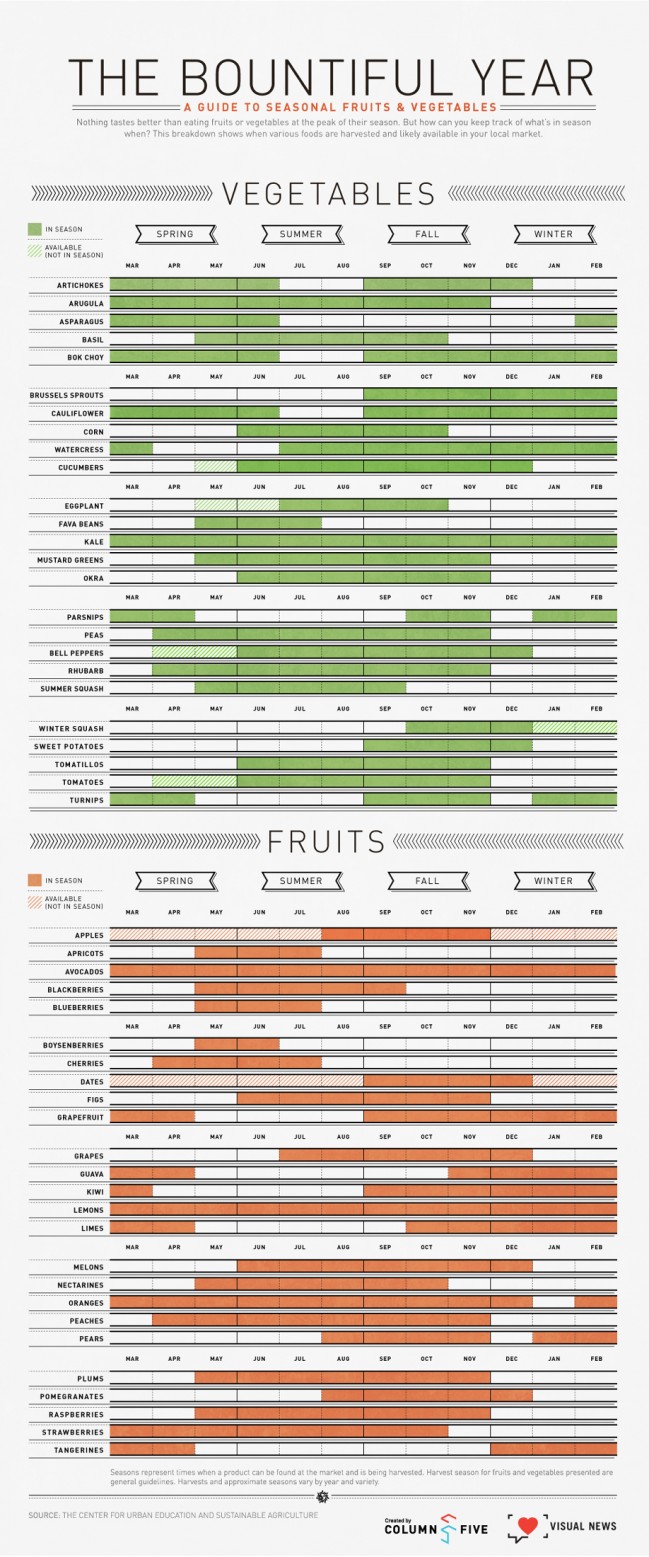

 A fascinating case study shows how Microsoft failed its employees through misguided HR (human resources) policies that pitted colleague against colleague.
 Robert J. Samuelson paints a sobering picture of the once credible and seemingly attainable American Dream — the generational progress of upward mobility is no longer a given. He is the author of “The Great Inflation and Its Aftermath: The Past and Future of American Affluence”.
 The United States is gripped by political deadlock. The Do-Nothing Congress consistently gets lower approval ratings than our banks, Paris Hilton, lawyers and BP during the catastrophe in the Gulf of Mexico. This stasis is driven by seemingly intractable ideological beliefs and a no-compromise attitude from both the left and right sides of the aisle.
 Ex-Facebook employee number 51, gives us a glimpse from within the social network giant. It’s a tale of social isolation, shallow relationships, voyeurism, and narcissistic performance art. It’s also a tale of the re-discovery of life prior to “likes”, “status updates”, “tweets” and “followers”.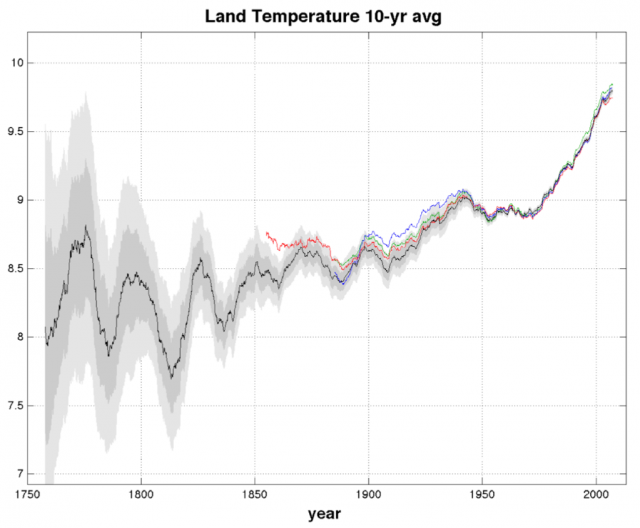
 The United States is often cited as the most generous nation on Earth. Unfortunately, it is also one of the most violent, having one of the highest murder rates of any industrialized country. Why this tragic paradox?
 Hot from the TechnoSensual Exposition in Vienna, Austria, come clothes that can be made transparent or opaque, and clothes that can detect a wearer telling a lie. While the value of the former may seem dubious outside of the home, the latter invention should be a mandatory garment for all politicians and bankers. Or, for the less adventurous, millinery fashionistas, how about a hat that reacts to ambient radio waves?
 We excerpt below a fascinating article from the WSJ on the increasingly incestuous and damaging relationship between the finance industry and our political institutions.
 When it comes to music a generational gap has always been with us, separating young from old. Thus, without fail, parents will remark that the music listened to by their kids is loud and monotonous, nothing like the varied and much better music that they consumed in their younger days.
 Yet another research study of gender differences shows some fascinating variation in the way men and women see and process their perceptions of others. Men tend to be perceived as a whole, women, on the other hand, are more likely to be perceived as parts.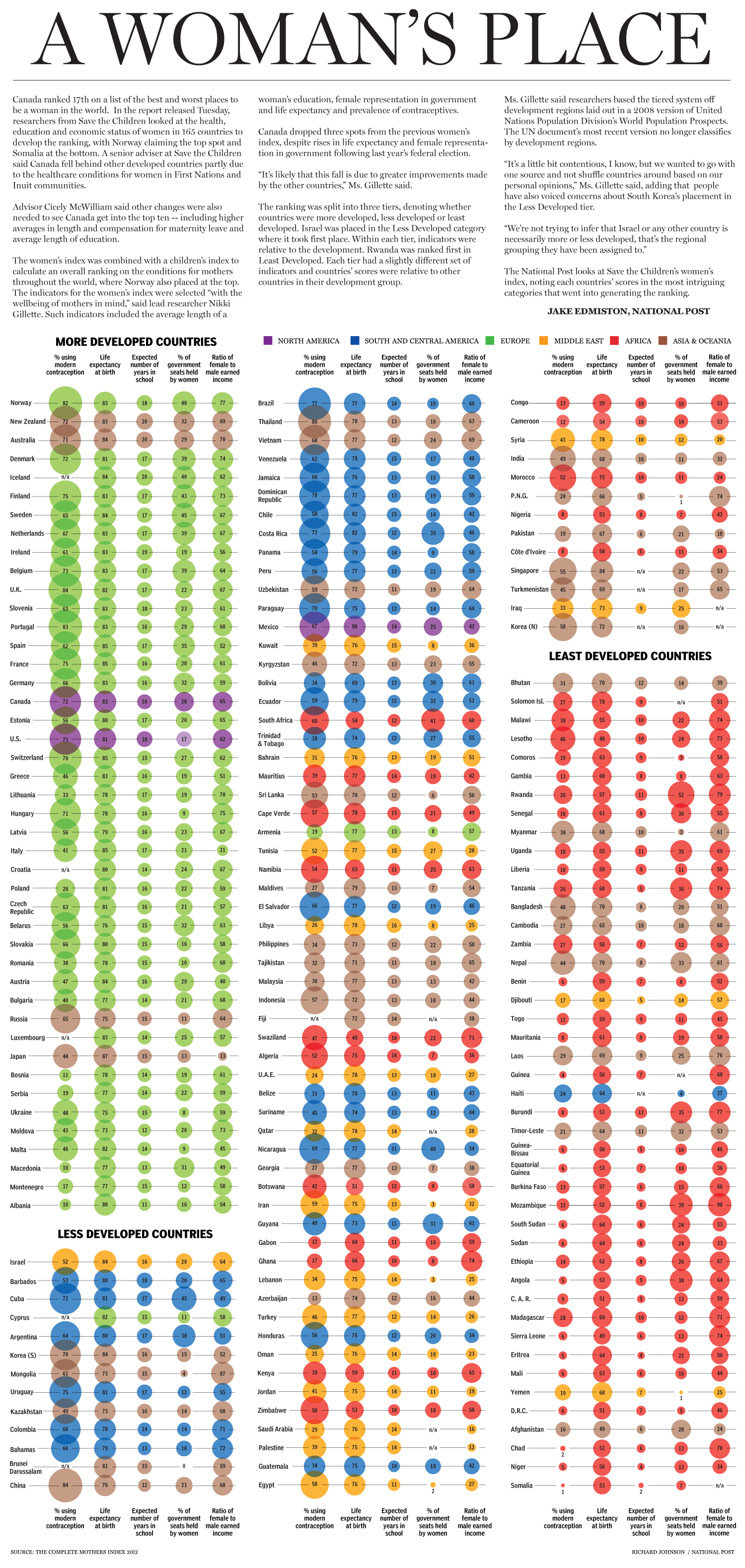
 For the first time scientists have built a computer software model of an entire organism from its molecular building blocks. This allows the model to predict previously unobserved cellular biological processes and behaviors. While the organism in question is a simple bacterium, this represents another huge advance in computational biology.
 Author and environmentalist Bill McKibben has been writing about climate change and environmental issues for over 20 years. His first book, The End of Nature, was published in 1989, and is considered to be the first book aimed at the general public on the subject of climate change.



 Procrastinators have known this for a long time: that success comes from making a decision at the last possible moment.

 Many people in industrialized countries often describe time as flowing like a river: it flows back into the past, and it flows forward into the future. Of course, for bored workers time sometimes stands still, while for kids on summer vacation time flows all too quickly. And, for many people over, say the age of forty, days often drag, but the years fly by.